Fungi Perfecti
How to Change Your MindFungi Perfecti is the mushroom company and research operation founded by Paul Stamets, linking commercial cultivation to experiments with fungi and applications across medicine, environmental restoration, agriculture, forestry, and national defense. The book presents the organization not simply as an outlet for Stamets’s expansive ideas but as a working enterprise: its grow rooms, research facilities, and products offer material evidence of sustained activity. Its significance lies in that conjunction of practical work and wide-ranging ambition, while the account leaves the specific results of many proposed applications unstated.
Founding and Development
Stamets founded Fungi Perfecti just after college. By the time the narrator visited, it had become a successful company, and a later note dates its operation to 1984. The company sold medicinal mushroom supplements, spores, kits for growing edible mushrooms, and other mushroom-related products. This commercial range placed fungi not only within the specialist setting of research but also in the form of goods intended for customers interested in mushroom cultivation and use.
The company’s products and research belonged to related but distinct parts of its work. Its business offered a way to distribute mushroom materials and cultivation supplies; its research facilities supported Stamets’s efforts to reproduce fungi and conduct experiments. The account does not provide sales figures, staffing levels, or a formal description of the organization’s structure. It does, however, establish Fungi Perfecti as both a business Stamets had built and an operating base for his scientific work.
Site and Facilities
The complex stood in an evergreen forest, a short walk from Stamets’s house. Its long, white metal buildings resembled Quonset huts or small hangars. Outside lay piles of wood chips, discarded fungi, and growing media: the visible materials of cultivation rather than a polished institutional façade. The physical setting connected the company’s work to the forests around it while also making clear that fungal research required specialized spaces and prepared materials.
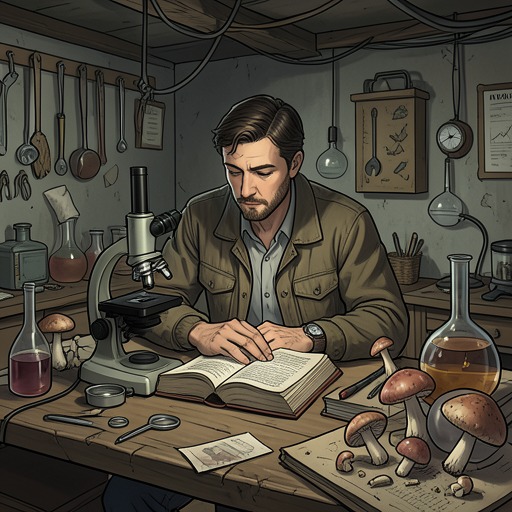
Some buildings contained grow rooms where Stamets raised medicinal and edible species. Others housed the research facility, including clean rooms and laminar flow chambers. There, he reproduced fungi from tissue culture and conducted experiments. These details distinguish the operation from a company concerned only with selling finished products: the site included dedicated facilities for propagation and investigation as well as cultivation rooms.
Framed patents hung on the office walls. The patents are not identified in the account, so they cannot be tied to any particular product or discovery. Their presence nevertheless formed part of the narrator’s impression of a functioning enterprise. Along with the laboratory equipment and grow rooms, they suggested a practical record of work behind Stamets’s public statements, without establishing that every expansive claim made on behalf of fungi had been demonstrated.
Research and Applications
The narrator describes Stamets as a researcher and entrepreneur whose work with fungi reached across an unusually broad set of fields: medicine, environmental restoration, agriculture, forestry, and national defense. Fungi Perfecti was the organization through which some of that work took material form. Its growing rooms supported the raising of medicinal and edible species, while tissue-culture work and laboratory experiments extended the company’s activity beyond routine cultivation.
The breadth of these interests is part of the organization’s identity in the book, but the evidence is not a catalogue of completed interventions. It does not specify which patents applied to which fields, describe particular defense projects, or report the outcomes of individual experiments. The distinction matters: Fungi Perfecti’s facilities demonstrate that Stamets was engaged in hands-on research and enterprise, while the account’s broad list of applications conveys the scope of his work rather than proving each proposed use successful.
Practical Work and Public Image
The narrator encountered Fungi Perfecti after listening to Stamets speak at length about fungal evolution and the possibility that insight from Psilocybes might help people find solutions to urgent problems. That talk prompted skepticism: his speculations seemed capable of straying from the researcher’s evidence into sweeping conjecture. The visit to the company’s buildings shifted the balance of the portrait. In the narrator’s reading, the facilities were a corrective to the impression that Stamets was merely a talker: he had built a company, cultivated fungi, conducted experiments, and patented work.
That contrast does not erase the gap between speculation and demonstrated result. Instead, Fungi Perfecti gives the book a concrete basis for holding both sides of Stamets’s character in view. The company’s clean rooms, grow rooms, culture work, and commercial products establish practical engagement with fungi; the reach of his aspirations remains a separate question. As portrayed, Fungi Perfecti is therefore both an enterprise in its own right and the material setting through which the narrator recognizes Stamets as a doer as well as an advocate.